
First time the NYT introduced me to Mamdani it was in the style section. The commentary referring to the look and feel, and the social media presentation of the candidate and the campaign. He was seen by the NYT as a competitor, but not a threat to Cuomo at the time.
It was late May, Bloomberg and company had no reason to fear. Why not feature the future false promise of a generation as a moment of style, a taste of spring that will fade by fall. Give the kids their time, the adults will be back after August.
With victory, the NYT finds again the proper place to highlight the generational shift in politics as a matter of fashion; the lede and copy about the cut of Mamdani’s suit, the price point and the symbolism of its fit. Somehow the political moment is about lapel size, not the mobilization of new young voters possessing a politics with no common denominator with those that own the Times.
To be fair in many ways it was a more honest approach than the savage editorializing of his campaign and policies positioned as news in the other sections. Cuomo having the charisma of a wet fart, the NYT could not find a space to talk about how his style benefited his campaign or any trace of appeal whatsoever.
One could argue this was an attempt at trivalizing Mamdani and the electoral coalition he built through such coverage. Perhaps there was an element of that. My more sinister take is the NYT is aestheticizing the political moment and politics generally. It’s what fascism does; turning political/practical discourse into an asethetic poetics. Moving issues and debate from the ethical and pragmatic into the judgemental. It is an intentional decentring of politics from the categories of practical reason to that of judgement and taste.
Benjamin saw this in the raise of fascism in general and Nazism in particular: the politics of performance. It is about turning political discourse into performance, into style, channelling the revolutionary desire into the poetic expression rather than actual political or social mobilization. Mamdani thus becomes an issue of style and presentation rather than rationale politics.
Turning everything into spectacle gives the illusion of public participation, while preserving the power structures of capitalism. If the NYT has any mission at all, it is about keeping the current power structures intact.
A coda
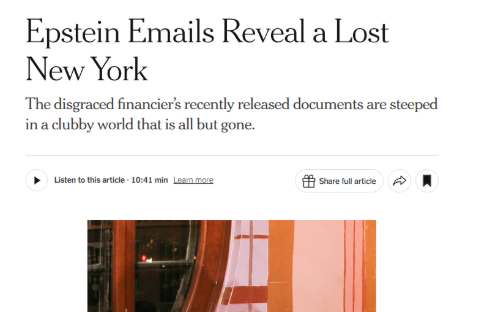
This has been the week of the Epstein files, the impending vote this coming week in Congress. And where does NYTimes bury the Sunday lede on all of this: the Style Section with the word disgraced vs child rapist and lament about how the feel good era of finance is gone.
 thelettrist